On January 1st, you know that this time it will be different. But come February 1st, the gym is back to silent, and come March, your meal prep containers are in the cupboard again. Have you ever had this experience? You’re not just undisciplined, you are human. Understanding why people quit healthy habits is crucial: most people’s healthy habits are neurologically set up for failure.
The reason that people give up on healthy habits is not to be a ding-dong didgeridoo of self-flagellation. It’s the first step in doing things differently. Each try gives hints as to what went wrong and, when used properly, the blueprint for success.
This guide explains the 7 most common reasons healthy habits fail and provides you with a research-backed “antidote” for each reason.
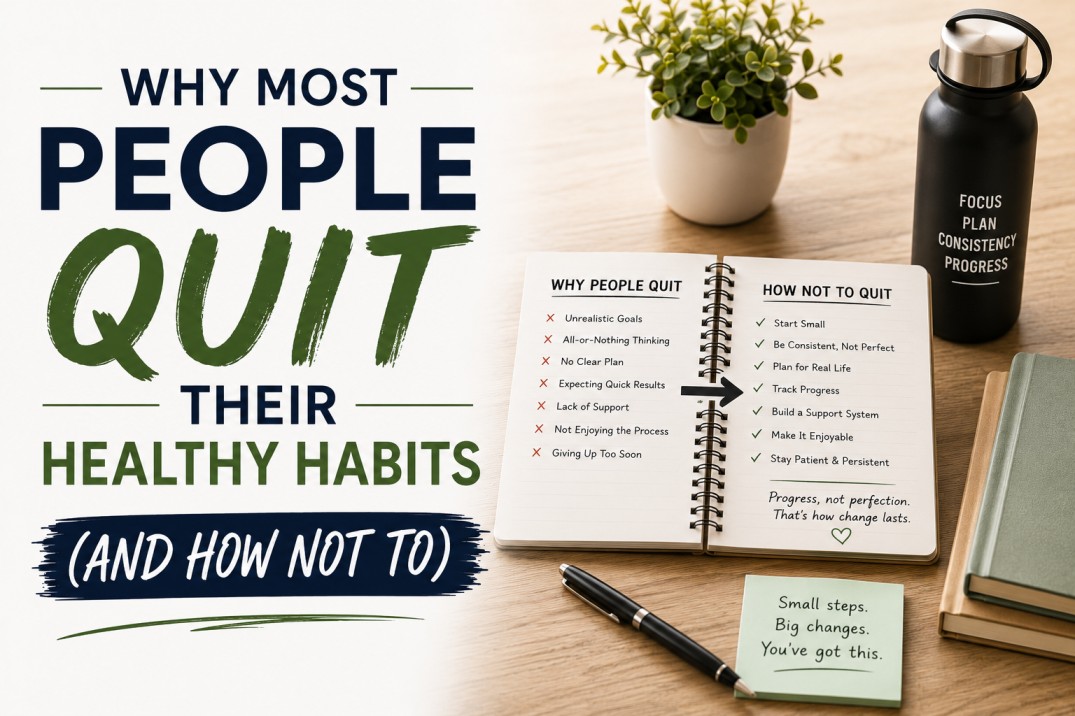
Why People Quit Healthy Habits: The 7 Real Culprits
Typically, the only types of tips for quitting healthy habits are those regarding motivation and mindsets. They’re below the level of structural issues. To truly understand why people quit healthy habits, we must look at the 7 root causes that cause almost all of the unhealthy habits to fail:
1. Starting Too Big and Too Fast
The most common excuse I hear for not getting fit is the “black and white” mentality: starting from no exercise to six workouts every week, or no processed food to cooking for all meals with all the vegetables. These changes in behavior are too big to fit into existing behaviors and are only made possible by motivation, which is limited and finite.
Neurologically, new behaviors are adopted through rational planning in the prefrontal cortex; they must be repeated to become part of the basal ganglia. Habits that involve a lot of effort from the prefrontal cortex start to burn out. It is important to begin small to enable the basal ganglia to take over earlier.
Antidote: The 2-minute rule. Make the new habit so small that it takes under two minutes to execute, such as two minutes of stretching, one glass of water, or a single push-up. These actions build the neural pathways that larger behaviors will eventually run on.
2. Outcome Goals Without Process Systems
Losing 20 pounds is an Outcomes Goal. It says where you want to be, but it doesn’t tell you how to behave on a daily basis. But when the scale doesn’t budge for two weeks (as frequently occurs), there is no guidance or small wins to hold onto, so the goal won’t help motivate.
One of the largest reasons people stop engaging in healthful pursuits is that they have goals without systems. Goals without systems have no feedback loop to keep behaviour going through the inevitable slow times.
Antidote: Supplement every outcome goal with a process commitment. For example, “I will walk for 20 minutes every day” or “I will add one vegetable to every meal.” These are achievable regardless of slow external results.
3. All-or-Nothing Thinking
A missed session may seem like a failure of the entire workout program, and one poor meal can make a diet look like a failure. Catastrophizing is a cognitive distortion that contributes to the greatest ratio of failure when attempting to change a habit and is a major reason people give up.
It is directly applicable to research done by Dr. Carol Dweck at Stanford on growth versus fixed mindsets: those who view setbacks as information are more likely to sustain the habit of challenging setbacks longer than those who view them as a verdict on character.
Antidote: Follow the “never miss twice” rule. One missed day is an accident, but two missed days are a choice. Commit to returning the day after a miss without guilt, compensation, or drama.
4. No Environment Design
Relying on willpower alone to maintain a healthy habit is like driving a car with a nearly empty tank. Willpower is a depletable resource. Research by Roy Baumeister at Florida State University demonstrated that self-control draws on a limited cognitive reserve that is reduced by use throughout the day.
If your environment makes unhealthy choices effortless and healthy choices difficult, willpower will eventually fail. This is not a weakness. It is physics.
Antidote: Design your environment to make healthy defaults easier. Put your running shoes by the door, keep vegetables at eye level in the fridge, and remove snacks from visible countertops. Each environmental change eliminates a decision and protects your habit.
5. No Accountability or Social Reinforcement
Habits practiced in isolation are fragile. Habits embedded in a social context are resilient. A study at the Dominican University of California found that people who shared their goals with a friend and sent weekly progress reports achieved 33% more than those who kept their goals private.
Yet most people treat their health habits as entirely private, sharing only results (if successful) and hiding failures. This removes the social reinforcement that human behavior evolved to depend on.
Antidote: Share your health commitment with at least one person. Better yet, find an accountability partner with similar goals or join a class where your participation is visible to others.
6. Reward Mismatch
The brain’s habit loop requires a reward signal. When that signal is too distant (the long-term health benefits of exercise arrive months later), the habit loop fails to close, and the behaviour does not consolidate into automaticity.
Many people unknowingly use punishment-based motivation (‘I will feel terrible if I skip’) rather than reward-based motivation, which is less sustainable and more psychologically costly.
Antidote: Engineer immediate, genuine rewards into your habit, such as a specific playlist available only during workouts or a favorite podcast for meal prep. The reward must follow the behavior immediately to close the loop.
7. Ignoring Recovery and Rest
Sustainable healthy habits include rest as a feature, not a bug. People who pursue health with relentless intensity, such as seven-day gym streaks, perpetual dietary restriction, and zero rest days, are among the most likely to burn out and quit entirely.
Physiologically, rest is when adaptation occurs: muscles repair, neural pathways consolidate, and hormonal systems reset. A healthy habit that includes scheduled recovery is more sustainable and more effective than one that demands constant maximal effort.
Antidote: Schedule rest explicitly, such as one full rest day per week from exercise or one flexible meal. Rest is not a failure; it is a vital part of the system.
How to Not Quit Healthy Habits: The Relapse Response Protocol
Knowing how not to quit healthy habits ultimately comes down to having a planned response to the inevitable relapse, such as the week you miss everything, the holiday where all routines collapse, or the emotional period where healthy choices feel impossible.
The protocol is simple: do not react emotionally to a relapse. Do not try to “make up” for missed sessions with punishing effort, and do not wait for Monday to restart. Simply return to the minimum viable version of your habit the very next day. Complete one action of any size and build from there.
This is how to not quit healthy habits in practice, not through perfect consistency, but through a reliable, low-drama return after every disruption.
Habit Relapse Prevention: Building a Routine That Bends Without Breaking
Effective habit relapse prevention is structural, not motivational. It is built into the design of the routine, not bolted on after the fact as a coping mechanism.
The three structural elements of relapse-resistant habits are: a minimum viable version (what the habit looks like at its lowest sustainable form), a return protocol (the specific action you take on Day 1 after any gap), and a reflection practice (a weekly five-minute review of what supported or undermined your habits that week).
Implement these three elements, and habit relapse prevention becomes a system rather than a hope.
Conclusion: Quitting Is a System Problem, Not a Character Problem
The most important insight about why people quit healthy habits is that failure is almost never about character, motivation, or willpower. It is about system design. The wrong system will defeat the strongest motivation. The right system will carry you through periods of low motivation.
Redesign your system, start smaller, build in rewards, engineer your environment, and plan for relapse, and consistency becomes the path of least resistance rather than a constant uphill battle.
At GrowHealth, we build the resources that help real people create real habits that last. Explore our guides on building weekly routines, morning habits, and staying consistent for a complete system.
FAQ
Why do people always quit healthy habits after a few weeks?
The most common reason is starting with a behavior that is too large and too demanding relative to current habits. The behavior requires constant willpower rather than becoming automatic, and willpower runs out. The solution is starting dramatically smaller than feels necessary.
How do I stop quitting my diet or exercise routine?
Replace the all-or-nothing approach with a minimum viable commitment. Define the smallest version of your routine that still counts, and commit to never dropping that minimum below, even during difficult weeks.
What is habit relapse prevention, and does it work?
Habit relapse prevention is the practice of designing a routine with explicit provisions for disruption, including a minimum viable version, a return protocol, and a weekly reflection practice. Research in behavioral psychology consistently shows that planning for failure significantly reduces its frequency and duration.