We’ve been had on a line about health improvement. The story is always the same: join the gym, eat the right foods, get up at 5 a.m., cleanse for 30 days. But most people don’t begin, since it sounds like hard work. And they never really get going until, within a few weeks, they burn out.
The reality of lasting health change isn’t quite as cinematic and much more attainable. Small habits that have great health benefits are not a compromise. They’re the mechanism. This is the principle of small habits big health results: simple, everyday health habits are more effective over time, in the long run, than dramatic health initiatives in the short run.
These are 7 tiny habits for better health that require less than 5 minutes a day and have been proven by research to be followed by some of the healthiest people around the world.
1. Drink a Glass of Water Before Every Meal
This could be the high-impact, simple healthy habit to start with. A study in the Journal of Clinical Endocrinology and Metabolism revealed that after 30 minutes of drinking 500ml (approx. 17oz) of water before a meal, metabolism can be raised by 24-30% for 60-90 minutes.
This also helps to lower the amount of calories consumed during the meal. In a 12-week study who pre-loaded with water lost 44% more weight than those who did not. It also fits into the existing behaviour seamlessly, as no extra time is required (you are already eating).
The first thing I do is drink a full glass of water when I start eating.
2. Take a 10-Minute Walk After Dinner
One of the simplest and healthiest things to do is to go for a 10-minute stroll after eating. A small post-meal walk proved more effective at regulating blood glucose levels than longer walks at other times of day and was shown to be effective in achieving glycaemic control in research published in Sports Medicine.
In this way, the 10-minute after-dinner ambidextrous stroll helps decrease blood sugar spikes, promote digestion, create a psychological finish line, and a little boost the mood through endorphin release. Four health benefits for an activity that uses no equipment, no gym membership, and adds no time block.
3. Do 10 Squats or Push-Ups When You Brush Your Teeth
You brush your teeth at least twice a day, so you have the trigger all ready. One of the most common uses of BJ Fogg’s Tiny Habits technique for implementing tiny habits for better health is to use a habit chain, where someone adds 10 bodyweight squats (in the morning) and 10 push-ups (in the evening) to an existing routine.
That’s 3,650 squats and 3,650 push-ups after a year. After one year, that’s 3,650 squats and 3,650 push-ups after a 2-minute investment each day. This is a positive cumulative training stimulus, especially for sedentary people. Small habits, big health results, indeed!
4. Spend 5 Minutes Outside Every Morning
But the morning light exposure is not a vitamin D thing, although it does help with vitamin D. It is mostly related to the calibration of the circadian rhythm. Your biological clock (suprachiasmatic nucleus) receives the signal from the retina to begin your day’s hormonal cycle by waking you up with cortisol, shutting off melatonin (for sleep) during the day, and getting your serotonin production started in the morning.
Dr Andrew Huberman at Stanford has extensively documented that 5–10 minutes of outdoor morning light (even on overcast days) is sufficient to deliver this effect, improving sleep, mood, focus, and energy levels for the rest of the day.
5. Replace One Scroll Session With 5 Minutes of Deep Breathing
The average person spends over 2 hours daily on social media. Replacing just one of those scroll sessions, typically the first one in the morning or the last one at night, with five minutes of slow, intentional breathing is one of the highest-ROI easy daily habits for health.
Diaphragmatic breathing activates the parasympathetic nervous system, reduces cortisol, lowers blood pressure, and improves heart rate variability (HRV), a key marker of cardiovascular and nervous system health. A 2017 study in Frontiers in Psychology found that just 20 sessions of slow breathing training produced measurable reductions in self-reported stress and improvements in attention.
6. Add One Vegetable to Every Meal
You do not need to go fully plant-based or track macros obsessively. Simply adding one additional vegetable to each meal, spinach to scrambled eggs, cucumber to a sandwich, broccoli to pasta, meaningfully increases fibre, micronutrient, and antioxidant intake without disrupting existing eating patterns.
The NHS recommends five portions of fruit and vegetables per day, yet only 28% of adults in England meet this target, according to Public Health England data. The addition rule bypasses dietary restriction, and instead of removing foods you enjoy, you simply expand what is already on the plate.
7. Write Down One Thing You Are Grateful For Before Bed
This takes 60 seconds. Its effects, however, operate at a neurological level. Gratitude practice activates the medial prefrontal cortex and releases dopamine and serotonin, and consistent practice has been linked to improved sleep quality, reduced symptoms of depression, and higher reported well-being in multiple clinical studies.
A landmark study by Emmons and McCullough (2003) found that participants who wrote weekly gratitude lists reported better sleep, fewer physical ailments, and greater optimism than those who documented daily hassles or neutral events. Daily practice amplifies the effect.
One sentence. One minute. Possibly the highest-return investment in your mental health toolkit.
How to Make These Tiny Habits for Better Health Stick
The key principle behind all seven of these tiny habits for better health is habit stacking: attaching new behaviours to existing anchors. You are not finding time, and borrowing it from behaviours that already run automatically.
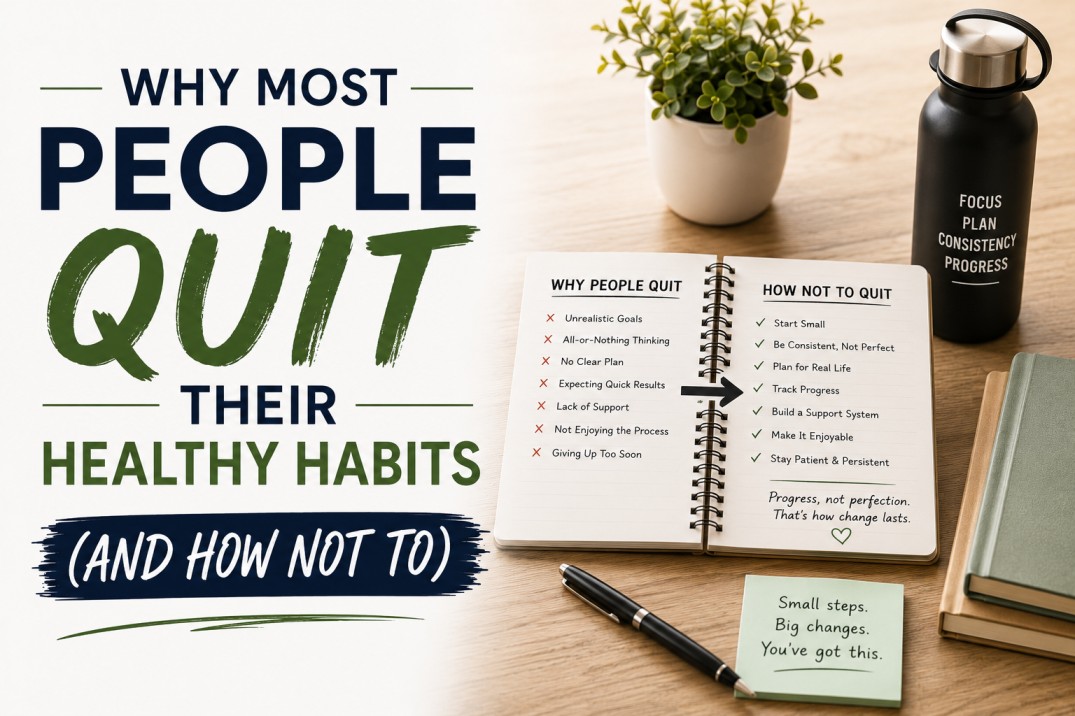
Do not try to implement all seven at once. Choose one, practise it for two to three weeks until it feels frictionless, then add the next. Track your streak on a simple calendar. Never miss two days in a row.
Conclusion: The Power of Small, Compounding Actions
Seven habits. Less than 30 minutes total per day. Yet the cumulative health impact of these simple tiny habits for better health practised daily for a year is genuinely significant: better metabolic health, improved cardiovascular function, stronger muscles, regulated nervous system, enhanced mood, and a sleep quality that makes everything else easier.
Health is not built in 30-day challenges. It is built in the unremarkable daily choices that stack up silently over months and years. Start with one of these today.
At GrowHealth, we help real people build real habits that last. Browse our full range of practical guides on fitness, nutrition, sleep, and mindset, and start where you are.