You start strong. Monday arrives, and you’re all in: meal prepped, gym pack, and alarm set at 6 AM. We have been missing twice since Thursday. On Sunday, you’ve discreetly put it away until next week. This isn’t a character defect, and it is a design issue.
Learning how to stay consistent with health goals is one of the most searched-for health tips, since it’s easy to get started, but hard to be consistent.
In this guide, I am not going to give you advice to “just believe in yourself” or “find your why. Those are helpful, but not enough. Real and consistent consistency is achieved via systems, identity changes, and authentic self-awareness. Here is how.
Why Consistency Is Harder Than It Should Be (And It Is Not Your Fault)
The brain is designed to seek the short term and minimize effort, which conflicts with health objectives. The short-term pain of exercise is worthwhile for the long-term gain. Junk food gives an instant hit of satisfaction, but it has delayed health repercussions. Your brain is not broken, and it works just like evolution intended.
Further, most people set goals (outcomes) instead of systems (processes). Goal is ‘Lose 10 pounds’. Eating after dinner every day for 20 minutes, ‘walk for 20 minutes after dinner daily’. Goals are either done or they aren’t done. Systems are cumulative, and each execution is easier than the last.
If you’re serious about consistency with your fitness program, you need to break up with the goal-setting model and adopt the system-building model. This isn’t motivational mumbo-jumbo, and it’s the neurobiology of habits put into practice.
The Identity Shift: The Key to How to Stay Consistent with Health Goals
In Atomic Habits, James Clear designs the most effective level of behavior change – identity change. Saying, “I want to exercise more” (an outcome) changes the decision-making from saying, “I am someone who moves their body daily” (an identity).
Each time you do something consistent with that identity, you vote for that identity in your brain, for 10 minutes at a time. This process is central to how to stay consistent with health goals, making consistency a journey, not a destination.
Consider a health goal as an identity statement. Not ‘I want to eat healthier’, but ‘I am someone who takes care of what I put in my body’. Use that identity to help make micro-decisions all day long.
5 Practical Strategies for Building Healthy Consistency
After changing your actions to match a new identity, you must have systems in place for execution each and every day. The next 5 strategies target minimizing friction, building momentum, and making consistency happen, rather than being a battle of willpower.
Strategy 1: Reduce the Minimum
Outline the minimum acceptable instantiation of each habit. Your minimum viable workout could be 10 minutes. Just one vegetable could be the minimum viable healthy meal. In times of difficulty, set the minimum (and not zero). It’s the quality, not the quantity, that is more important when it comes to maintaining identity.
Strategy 2: Make It Easy to Start
Most of the friction in health habits is in the beginning, not doing. Lay out your workout clothes the night before. Pre-chop vegetables on Sunday. Set your journal on your pillow. Environmental design removes the activation energy required to start.
Strategy 3: Track Visually.
A simple paper calendar where you cross off each day you complete your habit creates a visual chain you will not want to break. Research in behavioral psychology shows that visual tracking increases habit compliance by up to 18%; this is sometimes called the “Paper Clip Strategy” or the “Don’t Break the Chain” method.
Strategy 4: Plan for Failure
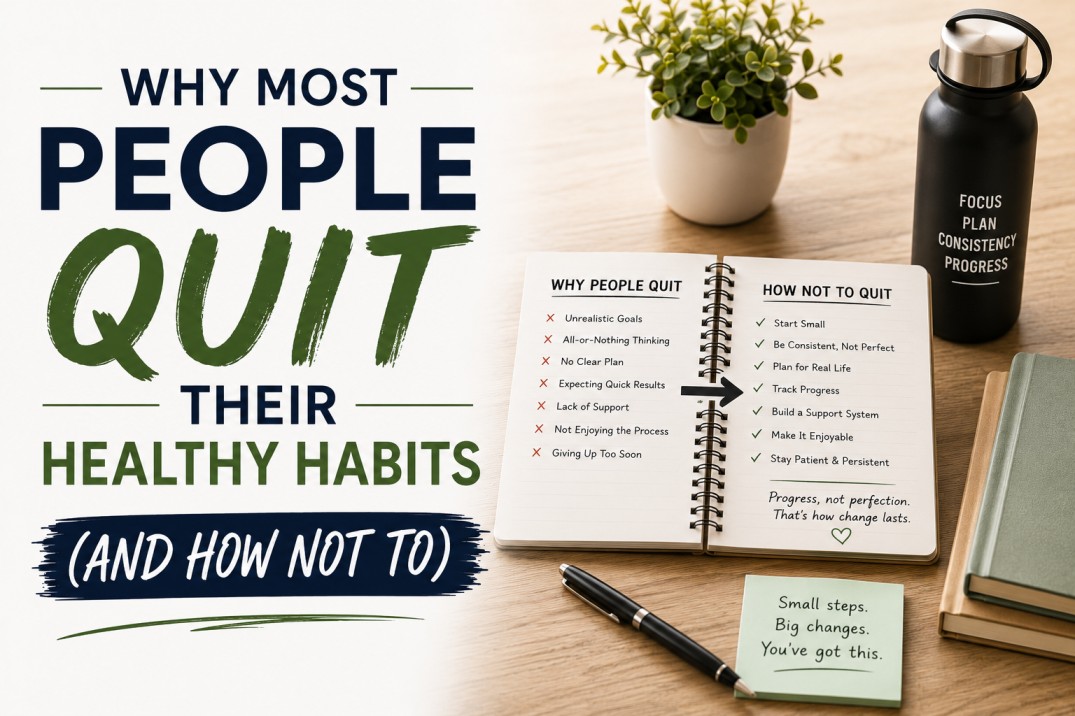
You will miss days. The question is not if, but how you respond. The rule is: never miss twice. One missed day is an accident. Two missed days are the beginning of a new pattern. Have a pre-planned response for common disruptions: travel, illness, and long workdays.
Strategy 5: Make It Enjoyable
Tips to stick to health goals are often about discipline, but enjoyment is far more reliable than willpower. Listen to your favourite podcast only during workouts. Choose a form of exercise you actually enjoy. Cook healthy meals with cuisines you love. Sustainability depends on pleasure, not punishment.
The Role of Accountability in Staying Consistent
External accountability is one of the most underused consistency tools. Telling someone your health goal increases your commitment rate significantly. Research by the Dominican University of California found that people who wrote down their goals and shared them with a friend achieved 33% more than those who kept their goals private.
Accountability does not need to be a personal trainer or a coach. A friend who texts you on Wednesday to ask if you completed your workout is sufficient. An online community or group chat with shared goals works. Even a public commitment on social media carries accountability weight.
When Progress Stalls: How to Stay Motivated During Slow Periods
Every health journey includes plateau periods: weeks where the scale does not move, where fitness does not seem to improve, or where motivation is at its lowest. These periods are not evidence that the approach is failing. They are normal features of biological adaptation.
During plateaus, refocus on process metrics rather than outcome metrics. Instead of tracking weight, track workout consistency, daily step count, water intake, and sleep duration. These metrics move even when the scale does not, and maintaining focus on them keeps the identity and behavior alive through periods when outcomes are invisible.
Building healthy consistency means building a relationship with the process, not the result. The result follows, but only if the process is maintained.
Conclusion: Consistency Is a Skill, Not a Personality Trait
If you have struggled with how to stay consistent with health goals before, it was not because you lacked willpower or dedication. It was because the system was not designed for the way humans actually behave. With the right architecture, such as small habits, identity alignment, environmental design, minimum standards, and honest accountability, anyone can build consistency that lasts.
Start with one habit. Make it almost insultingly easy. Do it every day. Build from there. That is the entire formula.
At GrowHealth, we create content for people who are serious about health but realistic about life. Browse our full library for practical guides on habits, staying consistent fitness routine, nutrition, and mindset, and find the approach that fits your real life.